AROPOP · PRODUCT AND SAFETY INFORMATION · SLEEP STICKER (LUNA) · DOC. AP-SL-01 · REV. 1.0
Sleep Sticker: what it is, what it does, and what it does not do
Product and safety information for parents considering a non-ingested, scent-based bedtime cue for children aged 3 and over.
Summary: A Sleep Sticker is a dry adhesive sticker infused with lavender essential oil, worn on clothing. Nothing is swallowed and nothing is applied to skin. It is not a medicine, it does not induce sleep, and no clinical trial has tested this product in children. It is intended as a repeatable sensory cue at the start of a bedtime routine.
Purpose of this document
This page is written for parents who want to check a product before buying it rather than read a story about it. It states what the Sleep Sticker contains, how it is meant to be used, who it is not suitable for, and where the limits of the evidence lie.
It is published by Aropop, the manufacturer. It is not an independent review and it is not medical advice.
Product description
A printed paper sticker with a pressure-sensitive adhesive backing, infused with lavender essential oil. Each pouch contains 24 stickers, printed with the character Luna.
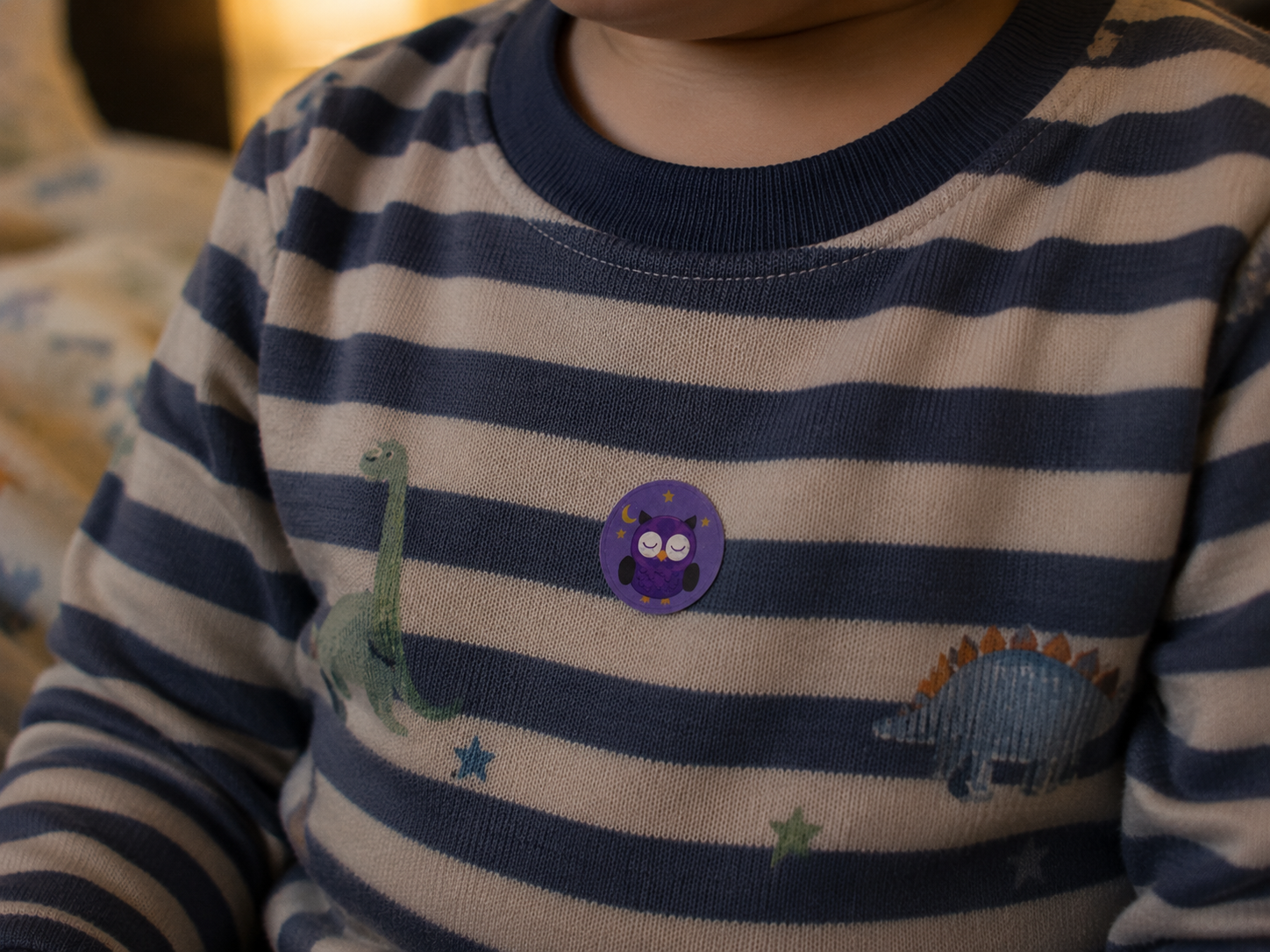
The sticker is applied to clothing, typically the front of a pajama top near the collar. The route of exposure is inhalation of the surrounding air. There is no intended skin contact and no ingestion.
Specifications
TABLE 1 — PRODUCT SPECIFICATION
- Format
- Dry adhesive sticker, applied to clothing. Single use.
- Active scent
- Lavender essential oil. Contains no camphor, eucalyptus, peppermint, rosemary or wintergreen.
- Route of exposure
- Inhalation of ambient air only. Not for skin contact, not for ingestion.
- Age range
- 3 years and over. Not suitable for infants or children under 3.
- Quantity and duration
- 24 stickers per pouch. Approximately 3.5 weeks at one sticker per night.
Instructions for use
- 01Let the child choosePresent the sheet and allow the child to select a sticker. The act of choosing is part of the intended routine; selecting on the child's behalf removes it.
- 02PeelRemove the sticker from the backing sheet. Most children aged four and over can do this unaided.
- 03Apply to clothingPress onto a pajama top, high on the chest or near the collar. Do not apply to skin, hair, bedding or soft toys.
- 04Remove and discardRemove the following morning and dispose of it. Do not launder the garment with the sticker attached.
Safety information and restrictions
Do not use:
- On children under 3 years of age.
- On skin, on the face, or near the eyes, ears, nose or mouth.
- On or near a child with asthma or another respiratory condition, without first consulting a pediatrician.
- On a child with a known allergy to lavender or to related plants.
Discontinue use if skin irritation, redness, coughing, wheezing or any change in breathing occurs, and contact a healthcare professional.
Choking hazard. Keep pouches and loose stickers out of reach of children under 3.
Johns Hopkins Medicine advises against using essential oils near a child's eyes, ears and nose, and notes that peppermint oil should not be used on children under 30 months because of an association with seizure risk. Aromatherapy safety guidance also advises avoiding eucalyptus, rosemary and other 1,8-cineole-rich oils on or around young children because of the risk of slowed respiration. None of these oils are used in this product.
What the evidence does and does not show
This is the section most product pages leave out. We think it is the most useful one.
No trial has tested this product. Aropop has not conducted or commissioned a clinical trial of the Sleep Sticker. Any claim that this product improves sleep in children would not be supported.
Research on lavender inhalation exists, but it is weak and it is not about children. Systematic reviews of aromatherapy for sleep quality have graded the certainty of the evidence as low to very low, with wide variation in study design, essential oil quality and dosing, and difficulty separating a scent effect from a placebo effect. Most trials were conducted in adults, frequently in hospital settings.
What we do claim. That a scent applied at the same point every evening becomes a recognizable signal that the day is ending, and that a child who chooses the sticker themselves participates in the routine rather than resisting it. That is a claim about routine and behavior, not about physiology.
Context: why some parents look for non-ingested options
Melatonin supplements are the most common over-the-counter sleep aid given to children in the United States, and their use has risen sharply. According to the CDC, poison control centers recorded 260,435 pediatric melatonin ingestions between 2012 and 2021, an increase of 530 percent over the decade. By 2020 melatonin had become the substance most frequently ingested by children reported to national poison control centers.
The great majority of these cases were mild. A study of poison center calls found that 98 percent of pediatric melatonin exposures resulted in minimal or no effects. However, over the same ten-year period more than 4,000 children were hospitalized, 287 were admitted to intensive care, five required mechanical ventilation and two died. Most incidents involved unsupervised access to flavored products by children aged five and under.
A separate concern is labeling accuracy: research has found discrepancies between the stated and actual melatonin content of products sold in the United States.
This is context, not a comparison. These figures describe accidental ingestion of a supplement. They do not demonstrate that a scented sticker is an effective substitute for anything, and we are not presenting it as one. They are included because they explain why a product that is not swallowed is of interest to some parents.
Sources
- Centers for Disease Control and Prevention. Pediatric Melatonin Ingestions — United States, 2012–2021. MMWR, June 2022. cdc.gov
- Centers for Disease Control and Prevention. Notes from the Field: Emergency Department Visits for Unsupervised Pediatric Melatonin Ingestion — United States, 2019–2022. MMWR, 2024.
- Johns Hopkins Medicine. Are Essential Oils Safe for Children? hopkinsmedicine.org
- International Federation of Aromatherapists. Aromatherapy with Children Guidelines.
- Systematic review and meta-analysis of aromatherapy and sleep quality in adults and older adults, Complementary Therapies in Clinical Practice, 2021. Certainty of evidence graded very low for sleep quality.
Sources are listed so that you can check them. Aropop is not affiliated with any of these organizations, and their publication does not constitute an endorsement of this product.
Ordering
Aropop Sleep Sticker · Luna · 24 stickers
$19.99Approximately 3.5 weeks at one per night. Multi-pouch options available. Go to product pageFree US shipping over $35 · 14-day returns · No subscription unless you choose one
Questions about ingredients, age suitability or safety can be sent to care@aropop.com. We answer every message.
Aropop stickers are a scented, non-medicated product worn on clothing. They are not a drug or a medical device and are not intended to diagnose, treat, cure, or prevent any disease or condition, including sleep disorders, anxiety, ADHD or autism. Not for children under 3. Apply to clothing only, do not apply to skin, and keep away from the eyes, nose and mouth. Discontinue use if irritation occurs. Keep out of reach of children under 3 to avoid choking. Consult your pediatrician with any questions about your child's sleep or health.
This document is published by Aropop and describes a product Aropop sells. It is a commercial communication. Document AP-SL-01, revision 1.0, last reviewed August 4, 2026.